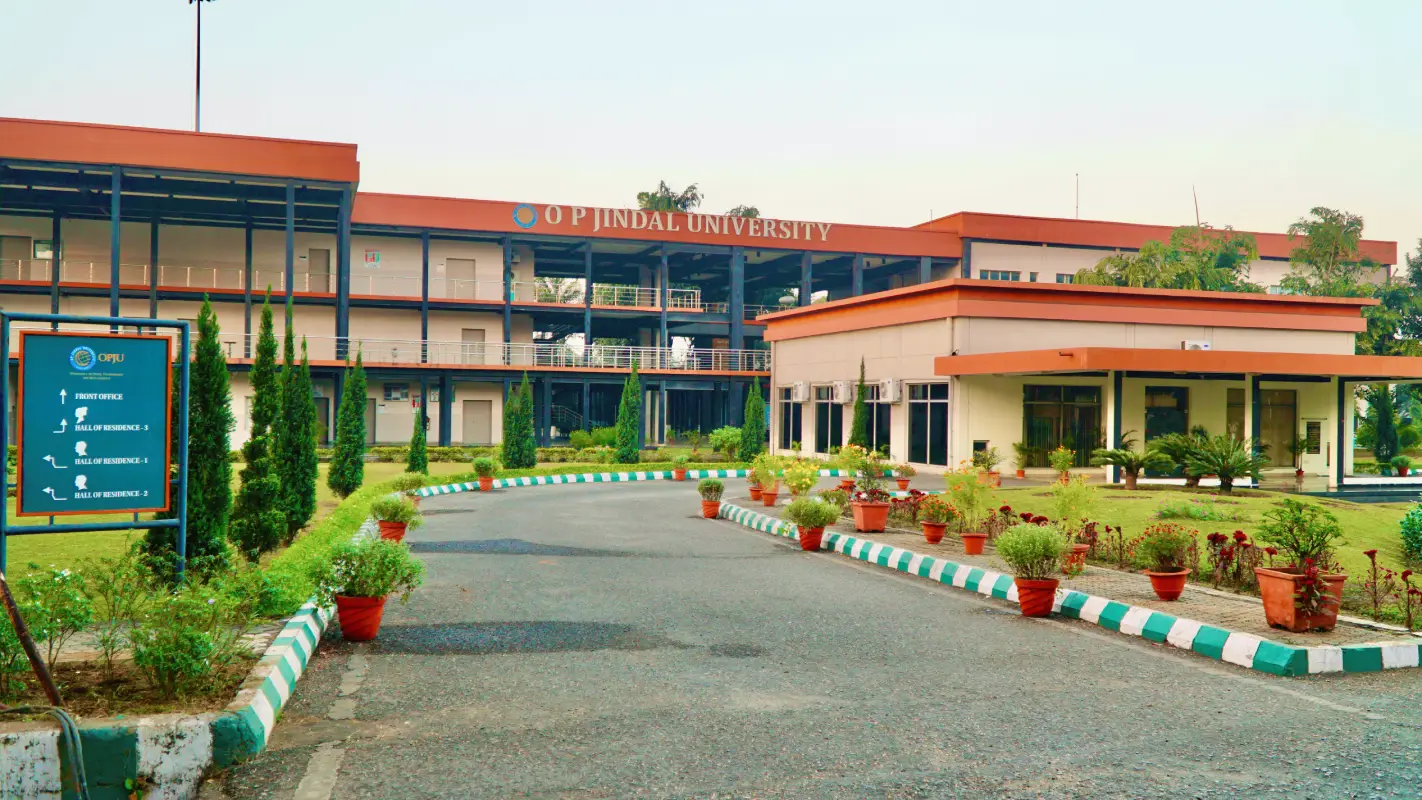
In today’s rapidly evolving industrial environment, continuous upskilling is essential for professionals to remain competitive, enhance productivity, and adapt to emerging technologies. To address this need, OPJU offers an B.Tech Program for Working Professionals in Mechanical Engineering, specifically designed for diploma holders and experienced industry personnel.
This program is structured as per the guidelines of the AICTE and is tailored to support working professionals in upgrading their qualifications without interrupting their careers. It is a flexible, industry-oriented degree program that bridges the gap between academic knowledge and industrial practice, enabling professionals to enhance their technical expertise and career growth.
Note: Candidates from reserved categories (SC/ST/OBC) of Chhattisgarh domicile and Female candidates are exempted from the application fee.
To view the detailed scholarships, Click Here .
• Approved by AICTE
• Designed exclusively for working professionals
• Flexible learning modes: weekend / evening / online classes
• Industry-relevant and updated curriculum
• Emphasis on practical and application-based learning
• Opportunity to work on real industry problems as projects
Candidates must meet the Lateral Entry eligibility criteria as specified by AICTE,
• Diploma in Engineering / Technology in a relevant branch OR B.Sc. degree with Mathematics (as applicable under lateral entry norms)
• Minimum 1 years of work experience in a relevant field
• Currently employed in industry
• Duration: 3 years (as per entry qualification and AICTE norms)
• Mode: Weekend / evening / online classes
• Credit System: As per AICTE curriculum structure
Apply knowledge of mathematics, natural science, computing, engineering fundamentals and an engineering specialization as specified in WK1 to WK4 respectively to develop the solution of complex engineering problems.
Identify, formulate, review research literature and analyze complex engineering problems reaching substantiated conclusions with consideration for sustainable development. (WK1 to WK4)
Design creative solutions for complex engineering problems and design/develop systems/components/processes to meet identified needs with consideration for the public health and safety, whole-life cost, net zero carbon, culture, society and environment as required. (WK5)
Conduct investigations of complex engineering problems using research-based knowledge including design of experiments, modelling, analysis & interpretation of data to provide valid conclusions. (WK8)
Create, select and apply appropriate techniques, resources and modern engineering & IT tools, including prediction and modelling recognizing their limitations to solve complex engineering problems. (WK2 and WK6)
Analyze and evaluate societal and environmental aspects while solving complex engineering problems for its impact on sustainability with reference to economy, health, safety, legal framework, culture and environment. (WK1, WK5, and WK7)
Apply ethical principles and commit to professional ethics, human values, diversity and inclusion; adhere to national & international laws. (WK9)
Function effectively as an individual, and as a member or leader in diverse/multi-disciplinary teams.
Communicate effectively and inclusively within the engineering community and society at large, such as being able to comprehend and write effective reports and design documentation, make effective presentations considering cultural, language, and learning differences.
Apply knowledge and understanding of engineering management principles and economic decision-making and apply these to one's own work, as a member and leader in a team, and to manage projects and in multidisciplinary environments.
Recognize the need for, and have the preparation and ability for: i) independent and life-long learning ii) adaptability to new and emerging technologies iii) critical thinking in the broadest context of technological change. (WK8)
PSO 1: Engineering Design and Analysis Apply fundamental and advanced knowledge of mechanical engineering to analyze, design, and optimize mechanical systems, components, and processes in areas such as manufacturing, thermal systems, and machine design.
PSO 2: Industrial Application and Problem Solving Utilize modern engineering tools, techniques, and practical skills to solve real-world industrial problems, improve productivity, and ensure efficient operation of mechanical systems in diverse industries.
PSO 3: Professional Competence and Lifelong Learning Demonstrate professional ethics, effective communication, and continuous learning to adapt to emerging technologies, contribute to organizational growth, and advance in their engineering careers.